

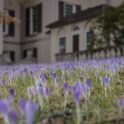
Tommy crocuses bloom across the East Terrace lawn at Winterthur, signaling the arrival of early spring in the historic gardens. Photo courtesy Winterthur Museum, Garden and Library.
Winterthur’s 75th Anniversary Season Kicks Off with Bank to Bend Garden Walk
The arrival of early spring will be celebrated on March 14 with Bank to Bend, an annual garden event that invites visitors to experience the first waves of seasonal color across the historic March Bank landscape.
Held from 10 a.m. to 3 p.m., the event marks the beginning of the 2026 season and the start of the museum’s 75th anniversary year. The day includes guided and self-guided garden walks, a plant sale, a clivia exhibit, a library open house, and a lecture by local author and horticulturist Rick Darke.
The event takes its name from a tradition established by Winterthur founder Henry Francis du Pont, who encouraged family members to walk the path along the March Bank to Magnolia Bend each year to observe and report the first flowers of the season emerging in the garden.
The March Bank is one of the best-known examples of the wild garden concept promoted by British gardener and writer William Robinson. In his 1870 book The Wild Garden, Robinson advocated planting hardy native and exotic plants in groupings that resemble natural landscapes rather than arranging them in rigid patterns.
Robinson challenged traditional English gardening practices by encouraging gardeners to allow plants to naturalize and establish themselves in self-sustaining communities. The approach was intended to create landscapes that were both resilient and visually dynamic.
Du Pont embraced Robinson’s philosophy when developing the March Bank, beginning plantings in 1902 when he was 22 years old. What started with a few thousand bulbs planted beneath a canopy of woodland trees eventually expanded into a sweeping naturalistic display that now includes millions of late-winter and early-spring-flowering bulbs.
The display begins to evolve in late January and continues through early May. The first blooms typically include white giant snowdrops, followed by yellow Amur adonis and winter aconite. As the season progresses, the landscape transitions to carpets of lavender-blue glory-of-the-snow and royal-blue squills.
Drifts of yellow daffodils appear next, followed by purple-and-white Dutch hybrid crocus and white bloodroot. By late March, the bank fills with emerging Virginia bluebells, Italian windflowers, and other naturalized plants.
Visitors attending Bank to Bend can explore the garden paths on their own or join scheduled activities throughout the day. A plant sale will offer cyclamens, perennials and unusual snowdrops, and guests can also attend a Director’s Garden and Estate Walk led by Winterthur CEO Chris Strand.
The Winterthur Library will also host a special collection open house in the afternoon.
For an additional $10, visitors can attend a lecture by Landenberg-based author and garden designer Rick Darke from 11 a.m. to noon in Copeland Lecture Hall. The talk, titled The Wild Garden in Our Time, will explore how naturalistic garden design continues to influence modern landscapes.
Darke is known for combining ecology, horticulture, and cultural geography in his work on the design of public gardens, parks, and residential landscapes.
Maintaining the historic garden remains an important responsibility for Winterthur’s horticulture team. One of the last remaining 20th-century wild gardens in the United States, the landscape is carefully managed to preserve the natural appearance envisioned by du Pont.
“Color is the thing that really counts more than any other,” du Pont once said of the garden he designed, grew and maintained for nearly 70 years.
“It’s a meticulous process that requires an understanding of the original design intent and keen observations to preserve its character,” said Linda Eirhart, Alice Cary Brown Director of Garden at Winterthur. “The wild garden style requires continuous care to maintain its desired appearance.”
Garden staff maintains historic plant combinations and seasonal views while also encouraging natural spreading of plants across the March Bank. Garden Manager Carol Long distributes seeds from certain spring bulbs to help expand the display, a process she calls “Johnny Appleseeding.”
Additional information about the March 14 event is available at
https://www.winterthur.org/event/bank-to-bend/

Delaware LIVE collaborates with a network of professional journalists to cover a diverse range of stories across various fields. Staff Writers include experienced journalists and young professionals. If you have questions, please feel free to contact editor@delawarelive.com or our publisher, George D. Rotsch, at George@Delawarelive.com