

Radley Run Country Club wants to have a seasonal cover over four of its tennis courts and presented the idea to the Birmingham Township Board of Supervisors Monday night. It was an exploratory presentation and no decision was made.
Attorney Lou Colagreco told supervisors there was some uncertainty about what type of permits would be needed, if any.
“Radley wants to enclose the courts for winter use, off-season use. A question arose, does this need land development approval? Frankly, I don’t think it does [because] it’s going over existing improvements,” Colagreco said. “There’s no new impervious [coverage], there’s no new stormwater management, no new anything.”
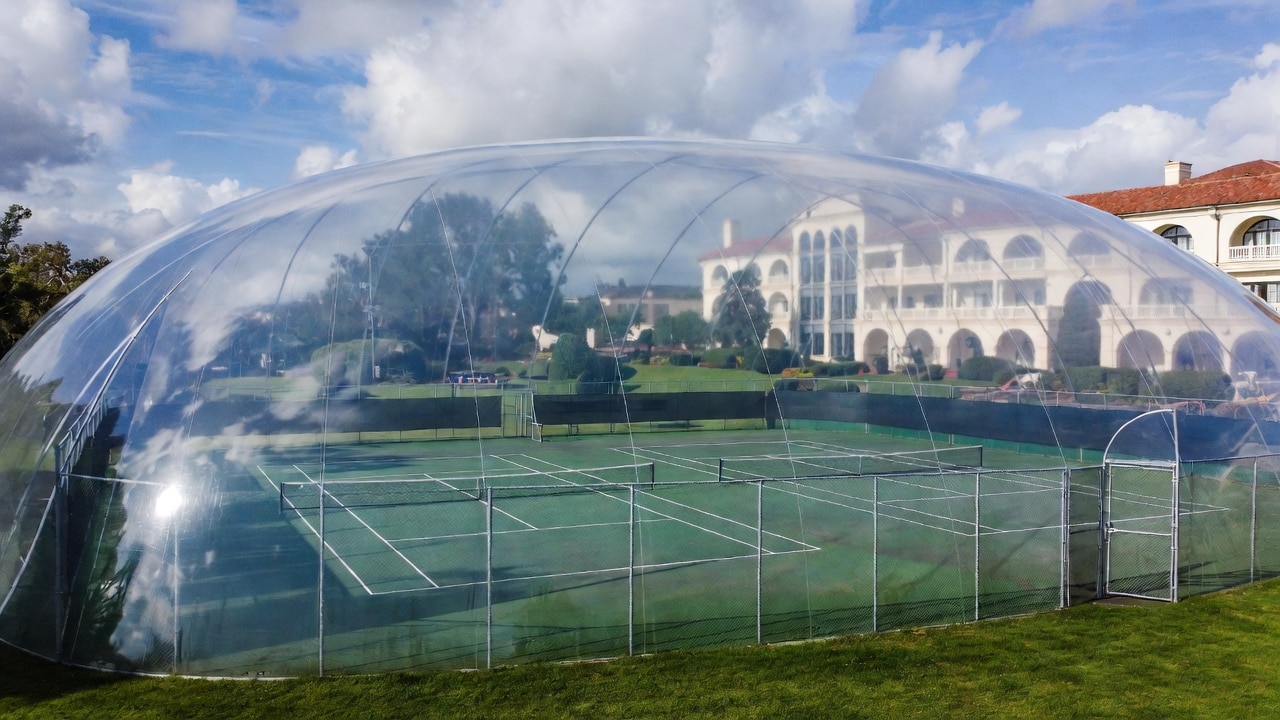
 The four courts in question were built in 2012 behind the old clubhouse. The proposed covering is portable and would only be up during the colder months, though no specific months for the seasonal enclosure were specified.
During the initial phase of the conversation, Supervisors’ Chairman Scott Boorse asked whether the coverage was a structure and whether it would be permanent or temporary.
Colagreco said it is a structure and that it would be temporary, up for maybe five or six months during the colder part of the year and taken down and stored during the warmer months. He also referred to it as a “portable structure.” He also said going through the land development process would reflect “an unnecessary bureaucracy.”
Speaking next was Kurt Hunter, a member of the country club board presenting as a club representative.
He said the cover is a single structure, 35 feet tall, made of a tan fabric with metal ribs to keep its shape. He referred to the cover as a bubble.
“We’re going to put this bubble over the top of these four courts,” adding there would be some foundations installed to hold the structure in place.
Once the foundation is set, it would take about 10 days to put the bubble up, and less time than that to take it down before folding it up and storing it until needed when the weather gets cold again.
Hunter said there are two other pieces of equipment needed for the bubble’s use. There would be no sewer use, but there would be an HVAC unit that would provide forced air and heat, a gas source, possibly propane or a public natural gas system, and an emergency generator.
Under questioning, he said there would be interior lighting, but no illumination of the exterior.
There are other tennis courts at the country club, but the cover is only for the four behind the old clubhouse.
Hunter added that Radley Run, the creek, is behind the courts, and behind it are seven homes within 500 feet of the courts. Each of the property owners were contacted about the project and, he said, “There was no pushback,” adding that three or four of the owners are members of Radley Run.
Upon further questioning from Boorse, Hunter said he personally spoke with four of the property owners and club General Manager Michael Sofia spoke with the other three.
The questioning then moved to stormwater management. Boorse asked whether the current stormwater management would suffice or if something more would be needed.
“I’m not saying there’s going to be any impervious coverage, but you’re changing the slope. Where does the water go,” Boorse asked. He also questioned whether the structure could maintain itself under a heavy snowfall or wind.
Hunter said it’s designed to hold up.
“Between snow and wind loads, it’s designed and built for what’s required by local codes,” Hunter replied.
Boorse then rephrased his question regarding stormwater.
“You currently have four flat surfaces, stormwater hits and there’s some sort of drainage…My concern is you’re now putting a bubble on top of that. That water is going to go somewhere else when it hits the top every time there’s a rain event. What stormwater management controls are going to contain that water? Can the existing controls handle that, or would there be additional stormwater management be necessary? Can that water be collected in the same manner as today?”
Hunter’s response was shorter than the question.
“This does not get piped into a basin,” he said. “The water that currently flows under the courts just exits. There’s no piping, it flows down to the creek.”
With no decision being made as to whether the idea requires land development approval, the presentation ended with Colagreco saying his client would provide a stormwater report and, if land development is required, the neighboring property owners would get a formal notification.

About Rich Schwartzman
Rich Schwartzman has been reporting on events in the greater Chadds Ford area since September 2001 when he became the founding editor of The Chadds Ford Post. In April 2009 he became managing editor of ChaddsFordLive. He is also an award-winning photographer.