
Wilson Gault Somers Continues His Mission Through Music with Lincoln Legacy
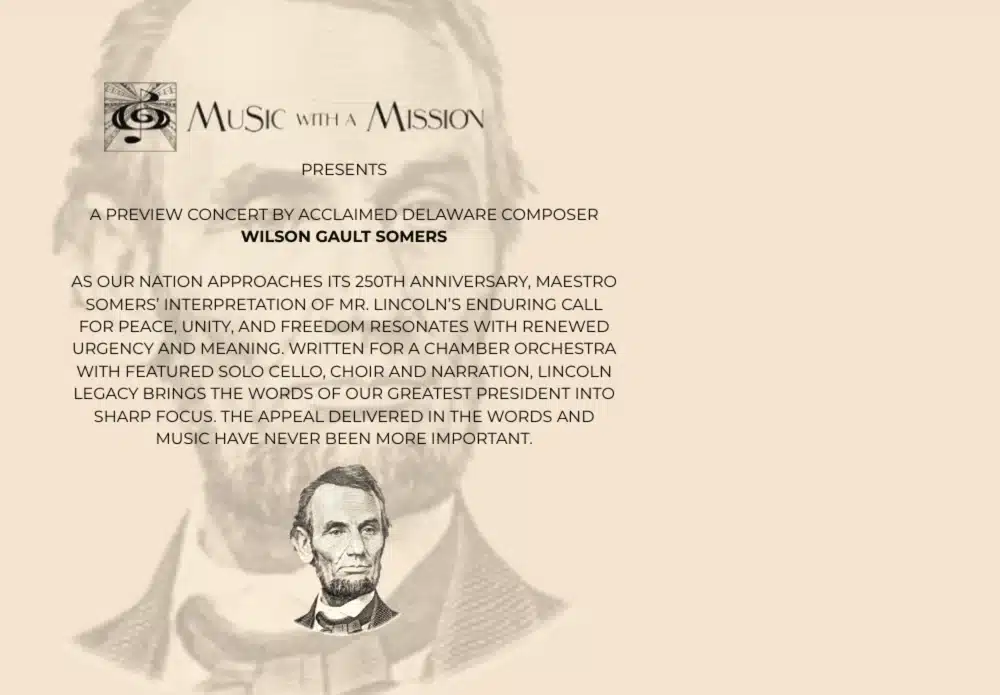
A new major work by Delaware composer Wilson Gault Somers will preview on March 8 at St. Helena’s Roman Catholic Church in Wilmington. Titled “Lincoln Legacy,” the composition marks Somers’ third large scale original work and continues a decades long commitment to pairing music with meaningful causes.
Somers, a Delaware native, has built a respected career as a composer, conductor, and performer in both classical and jazz traditions. For 30 years, he served as director and teacher of choral music at The Tatnall School before retiring at the end of the 2021 to 2022 academic year. He continues as Music Director at The Episcopal Church of the Advent in Kennett Square, Pennsylvania.
“Lincoln Legacy” was inspired through Somers’ work at Advent and a collaboration with the former Headmaster of Church Farm School in Exton, Pennsylvania, the Reverend Edmund “Ned” Sherrill. Church Farm School serves high school boys, many from marginalized communities in West Philadelphia and the five boroughs of New York City, offering what Somers describes as a high end private school education with tools to become successful members of society. Most of the students are African American, and 100 percent of graduates attend college.
Lincoln’s own words before his assassination in 1865, when he spoke of the need for the descendants of enslaved people to be educated, resonated deeply with Somers. That connection became personal in February 2022 when he designed a Concert of Spirituals to honor Black History Month. He invited Reverend Sherrill to read the Gettysburg Address before a performance of “The Battle Hymn of the Republic.” Sherrill instead brought two scholars from Church Farm School, one white and one Black, to read the address in tandem.
“The effect was profound,” Somers recalls. The moment inspired Movement II, The Aftermath of Gettysburg, in which the Gettysburg Address is read before the choir sings Lincoln’s closing words: “that this nation under God, shall have a new birth of freedom, and that government of the people, by the people, for the people shall not perish from the earth.”
From there, the rest of the composition fell into place. “Lincoln Legacy” unfolds in five parts: Prelude to War and The Battle; The Aftermath of Gettysburg; The Sacrifice of the Faithful; The Bridge of Hope and Atonement; and Forgiveness, Reconciliation and Renewal.
Somers’ earlier works shaped his vision for this new piece. His “Mass for the Homeless” debuted in 1997 at The Grand Opera House in Wilmington and returned in 1999, raising more than $60,000 for organizations serving homeless individuals. In response to the September 11 attacks, which claimed the lives of two people close to him, Somers composed “Requiem for 9/11.” The work premiered in 2012 at The Grand Opera House, with proceeds benefiting the Flight 93 National Memorial.
The composition honors what Somers calls the “Triumph of the Human Spirit,” paying tribute to first responders, the citizen soldiers aboard Flight 93, and the men and women in uniform who answered the call. “Requiem for 9/11” will receive a full performance this November by the Newark Symphony Orchestra and Chorus under the direction of Maestro Simeone Tartaglione as part of America’s 250th commemoration.
“I am a patriot and I love this country so much that I would be willing to lay down my life for it,” Somers says. “We, the citizens of the United States, need to remember every day that people have sacrificed so much so that we can breathe the free air. Freedom isn’t free.”
Lincoln’s legacy, Somers explains, rests in two defining achievements. First, he preserved the Union after the attack on Fort Sumter. Second, he ended legal slavery, first through the Emancipation Proclamation as a war measure and later by pushing for the passage of the 13th Amendment in January 1865. Lincoln also declared that “Democracy is the last, best hope for mankind” and offered a moral compass in the words, “As I would not be a slave, so I would not be a master.”
Making “Lincoln Legacy” an American work allowed Somers to draw from Duke Ellington, Dizzy Gillespie, and gospel composer Jester Hairston. Their influence is most evident in the final movement, Forgiveness, Reconciliation and Renewal. “When was the last time you heard a classical symphony and were able to tap your toes in the final movement,” he asks. “Welcome to America.”
With “Lincoln Legacy,” Somers once again blends history, remembrance, patriotism, and artistic expression. As the nation approaches its 250th anniversary, the work invites audiences to reflect on sacrifice, unity, reconciliation, and what Lincoln called “a new birth of freedom.”
To purchase tickets visit https://

About Jamie Kleman
Jamie Kleman is a children’s author, playwright, TEDx speaker, and the Executive Producer of It’s Not Mean to be Green, an award-winning book and musical that toured for two years and launched a national Make a Monster Difference movement. She is the creator of the It’s Not Mean to be Green Camp and Licensing Program, a turnkey theatre and sustainability curriculum adopted by schools, libraries, museums, homeschool networks, and youth organizations.