
My tiny brain sees life in lists and expectations set in stone. And when things stray from that list, I freak out.
I’ve been a volunteer at the Sanderson Museum on Creek Road since 1997. We’ve been getting ready for America 250. The museum houses over 18,000 artifacts in the eight rooms and archives. We identified a list of over 30 amazing artifacts that date to the founding of our country.
Curating an exhibit is like writing a thesis. Before you start, you delineate and define. Since some of the artifacts, such as cannon balls, musket flints, and British breast buckles, were found on the Brandywine Battlefield, this meant defining the Brandywine Battlefield. Yes, I see you raising your hands. It’s the park on Route 1 just east of the village, right?
Well, not exactly. The Brandywine Battle was a running battle fought on September 11, 1777, covering over 15 square miles or 35,000 acres. Kennett Square to the Brandywine, north to near Marshalton, south to Radley Run and Dilworthtown in an outflanking movement. When the state created the 52-acre Brandywine Battlefield State Park in 1949, the Arthur Cleveland family, whose farm was now being confiscated, was told, “We don’t want to save the battlefield, we want to have a park on a state highway.”
It was 1949.
A second concept that’s extremely important when curating a collection is authenticity.
The two strands of George Washington’s hair were authenticated by the Curator of Presidential Hair at the Museum of Natural History, now part of Temple University. Really, I’m not kidding!
The c.1775 Viola d’Amore was authenticated at David Bromberg’s (Now R. Teal Wintsch Violinmaker) Fine Violins in Wilmington.
The book Noveaux Opuscules from Benjamin Franklin’s personal book collection was authenticated by the librarian at Franklin’s Library Company of Philadelphia, where Sanderson bought it at auction in the 1940s. The family library was still hurting after the Depression.
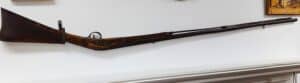
Our Fowler Musket was authenticated by an 18th-century weapons expert who had lectured at the Chester County History Center. Many people remark when seeing the musket on the wall above the mantle, “It’s hanging upside-down!” The only way we knew to answer was wherever Chris and his mother, Hannah, lived; the musket was always hanging upside-down. Fast forward to a recent tour of N.C. Wyeth’s studio is just south of the Brandywine Museum of Art.
There were two muskets hanging upside down on the wall. Our docent told us that an upside-down musket, facing away from the door, signified a friendly house.
It makes sense. N.C. Wyeth and Chris, both born in 1882, were good friends.
But then there’s the cup and saucer. The story was that it had been thrown down a well in Nantmeal for protection upon hearing cannons from Brandywine.
Enter antiques expert Mary Ann Ulmann. who pronounced, “That’s Gaudy Welsh!”
I snapped a picture with my cellphone and asked Google Lens. Sure enough. Dozens of pictures came up with identical brightly-colored mid- 19th century Gaudy Welsh China.
My list was beginning to crack.
Next came displaying the artifacts, writing the visitors’ guide, and creating the labeling.
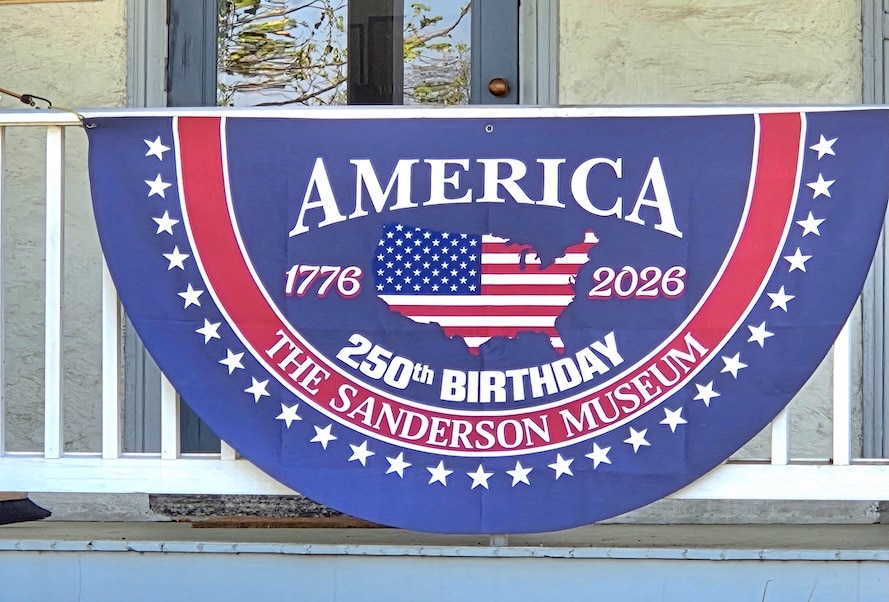
But we needed colorful exterior signage because driving past the Sanderson Museum is all too easy. So, we ordered a colorful six-foot America 250 non-pleated fan flag, with the name Sanderson Museum across the bottom. For days, there was no communication except for the charge to my credit card. I filled out their email form and got a reply. But it sounded like A.I.
I want a warm person at a computer. I felt a freak-out coming on.
I finally got the tracking information, which didn’t make me feel any better. While the company was headquartered in New York City, the flags were being shipped from Ho Chi Minh City (Saigon).
I felt calmer when tracking finally said it had made its way through customs at JFK Airport.
It was an educational experience, and I was grateful for the support of museum curator Chuck Ulmann, board members Jim Christ and Linda Banks.
America 250, the Founding Years, is now on display at the Sanderson Museum.

About Sally Denk Hoey
Sally Denk Hoey, is a Gemini - one part music and one part history. She holds a masters degree cum laude from the School of Music at West Chester University. She taught 14 years in both public and private school. Her CD "Bard of the Brandywine" was critically received during her almost 30 years as a folk singer. She currently cantors masses at St Agnes Church in West Chester where she also performs with the select Motet Choir. A recognized historian, Sally serves as a judge-captain for the south-east Pennsylvania regionals of the National History Day Competition. She has served as president of the Brandywine Battlefield Park Associates as well as the Sanderson Museum in Chadds Ford where she now curates the violin collection. Sally re-enacted with the 43rd Regiment of Foot and the 2nd Pennsylvania Regiment for 19 years where she interpreted the role of a campfollower at encampments in Valley Forge, Williamsburg, Va., Monmouth, N.J. and Lexington and Concord, Mass. Sally is married to her college classmate, Thomas Hoey, otherwise known as "Mr. Sousa.”